
Overview
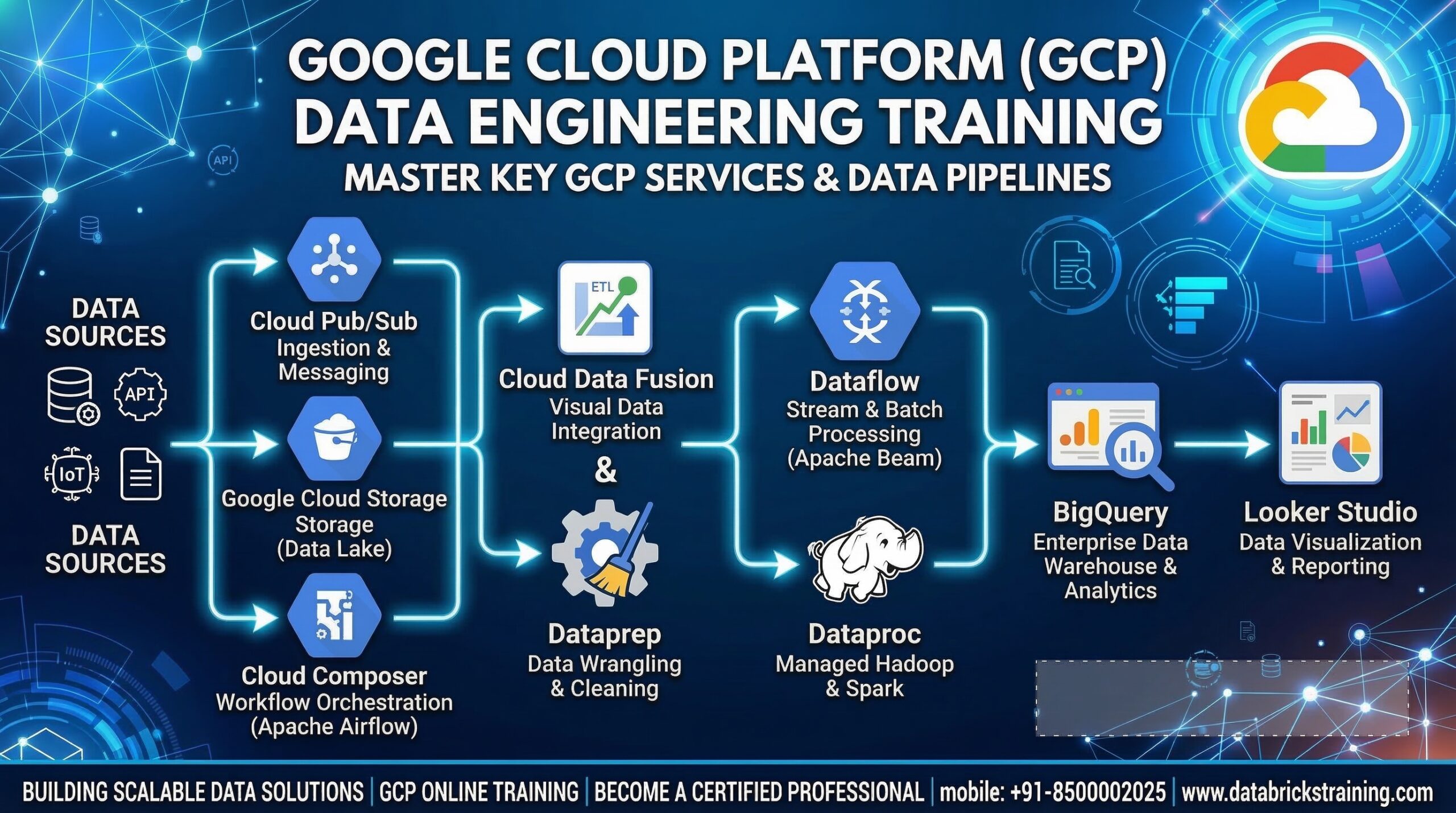
This is a complete hands-on GCP Data Engineering Training covering
all major Google Cloud data services — BigQuery, Dataflow, Dataproc,
Pub/Sub, Cloud Composer, Dataplex, Data Catalog, Datastream and more.
You will build real production pipelines on actual GCP accounts with
hands-on labs, real datasets and industry patterns used at Google,
Deloitte, TCS and Accenture.
What You Will Learn
✅ Build scalable data lakes on Cloud Storage — Bronze, Silver, Gold
✅ Master BigQuery — best practices, optimization, security
✅ Build batch pipelines using Dataproc and PySpark
✅ Build streaming pipelines using Dataflow and Apache Beam
✅ Handle real-time events with Pub/Sub
✅ Implement CDC pipelines using Datastream
✅ Orchestrate pipelines end-to-end with Cloud Composer (Airflow)
✅ Govern data with Dataplex and Data Catalog
✅ Deploy CI/CD using Cloud Build, GitHub Actions and Terraform
✅ Monitor pipelines with Cloud Monitoring and Cloud Logging
✅ Build 3 end-to-end capstone projects for your portfolio
✅ Clear the GCP Professional Data Engineer certification exam
Course Modules at a Glance
Module 1 — Cloud & GCP Fundamentals
Module 2 — GCP IAM & Security
Module 3 — Cloud Storage — GCP Data Lake
Module 4 — BigQuery Core Concepts & Architecture
Module 5 — BigQuery SQL & Advanced Querying
Module 6 — BigQuery Best Practices & Optimization
Module 7 — BigQuery Python & Automation
Module 8 — Cloud SQL — Managed Relational Database
Module 9 — Cloud Spanner — Globally Distributed Database
Module 10 — Cloud Bigtable — Wide Column NoSQL
Module 11 — Pub/Sub — Real-Time Messaging
Module 12 — Dataflow — Unified Batch & Streaming
Module 13 — Dataproc — Managed Spark & Hadoop
Module 14 — Cloud Composer — Pipeline Orchestration
Module 15 — Dataplex — Data Mesh & Governance
Module 16 — Data Catalog — Metadata Management
Module 17 — Datastream — Change Data Capture
Module 18 — GCP Pipeline Architecture Patterns
Module 19 — CI/CD for GCP Data Engineering
Module 20 — GCP Monitoring & Observability
Module 21 — End-to-End Capstone Projects
Module 22 — GCP Professional Data Engineer Exam Prep
Who Is This Course For
👨💻 Developers moving into GCP Data Engineering
🔄 ETL developers upgrading to cloud-native GCP tools
☁️ AWS or Azure engineers adding GCP to their skills
📊 Data Analysts transitioning into Data Engineering
🎓 Graduates targeting Data Engineer roles at top MNCs
🏆 Professionals preparing for GCP Professional Data Engineer exam
Prerequisites
– Basic Python — loops, functions, file handling
– Basic SQL — SELECT, JOIN, GROUP BY
– No prior GCP experience needed — start from scratch
– Laptop with internet — all labs run on GCP free tier
GCP Services Covered
☁️ Cloud Storage — Data Lake
🔍 BigQuery — Serverless Data Warehouse
⚡ Dataflow — Batch & Streaming (Apache Beam)
🖥️ Dataproc — Managed Spark & Hadoop
📨 Pub/Sub — Real-Time Messaging
🗄️ Cloud SQL — Managed PostgreSQL & MySQL
🌐 Cloud Spanner — Global Distributed Database
📦 Cloud Bigtable — Wide Column NoSQL
🎼 Cloud Composer — Apache Airflow
🏛️ Dataplex — Data Mesh & Governance
📋 Data Catalog — Metadata & Discovery
🔄 Datastream — Change Data Capture CDC
🔐 IAM & Secret Manager — Security
📊 Cloud Monitoring & Logging — Observability
🚀 Cloud Build & GitHub Actions — CI/CD
🏗️ Terraform — Infrastructure as Code
3 Capstone Projects
Project 1 — Batch Medallion Data Platform
Cloud SQL → Datastream → GCS → Dataproc →
BigQuery → Composer Orchestration → Looker Studio
Project 2 — Real-Time Streaming Pipeline
Pub/Sub → Dataflow Streaming → BigQuery →
Looker Studio Real-Time Dashboard
Project 3 — Serverless Event-Driven Pipeline
GCS Upload → Cloud Functions → Dataflow →
BigQuery → Dataplex DQ → CI/CD with Terraform
Course Features
- Lectures 245
- Quiz 0
- Duration 10 weeks
- Skill level All levels
- Language English
- Students 0
- Assessments Yes
Curriculum
- 20 Sections
- 245 Lessons
- 10 Weeks
- Module 1: Cloud & GCP Fundamentals for Data Engineers9
- 1.1What is Google Cloud Platform & Why GCP for Data Engineering
- 1.2GCP Global Infrastructure — Regions, Zones, Projects
- 1.3GCP Free Account Setup & Console Overview
- 1.4GCP CLI — gcloud SDK Setup & Configuration
- 1.5GCP IAM — Projects, Service Accounts, Roles & Permissions
- 1.6GCP Billing & Cost Management
- 1.7GCP Python SDK — google-cloud libraries Overview
- 1.8Core GCP Data Services Overview for Data Engineers
- 1.9Lab: Create GCP Project, Set Up gcloud CLI, Create Service Account
- Module 2: GCP IAM & Security for Data Engineers9
- 2.1GCP IAM — Users, Groups, Service Accounts
- 2.2IAM Roles — Primitive, Predefined & Custom Roles
- 2.3Service Account Keys vs Workload Identity Federation
- 2.4IAM Best Practices — Least Privilege Principle
- 2.5GCP Secret Manager — Store & Access Credentials Securely
- 2.6Accessing Secrets from Python — google-cloud-secret-manager SDK
- 2.7VPC & Private Access for Data Services
- 2.8Encryption at Rest & In Transit on GCP
- 2.9Lab: Create Service Account, Assign Roles, Store Secrets in Secret Manager
- Module 3: Cloud Storage — GCP Data Lake13
- 3.1What is Cloud Storage & Core Concepts
- 3.2Buckets, Objects, Folders & Naming Conventions
- 3.3Storage Classes — Standard, Nearline, Coldline, Archive
- 3.4Lifecycle Management Policies — Auto-Transition & Delete
- 3.5Cloud Storage Access Control — IAM & ACLs
- 3.6Signed URLs — Temporary Secure Access
- 3.7Cloud Storage as Data Lake — Bronze, Silver, Gold Layers
- 3.8Partitioning Strategy for Data Lake on GCS
- 3.9Uploading & Downloading Files using Python (google-cloud-storage SDK)
- 3.10Cloud Storage Event Notifications — Trigger Pipelines on Upload
- 3.11Cloud Storage Transfer Service — Migrate Data from AWS S3 / Azure
- 3.12Lab: Build GCP Data Lake on Cloud Storage — Bronze/Silver/Gold
- 3.13Lab: Upload & Read Files from GCS using Python SDK
- Module 4: BigQuery — Core Concepts & Architecture13
- 4.1What is BigQuery & Serverless Data Warehouse Architecture
- 4.2BigQuery Architecture — Storage & Compute Separation
- 4.3BigQuery vs Traditional Data Warehouse
- 4.4Datasets, Tables, Views & External Tables
- 4.5BigQuery Data Types & Schema Design
- 4.6Partitioned Tables — Date, Integer, Ingestion-Time Partitioning
- 4.7Clustered Tables — Improve Query Performance
- 4.8BigQuery Storage Formats — Capacitor (Columnar)
- 4.9Loading Data into BigQuery
- 4.10Exporting Data from BigQuery to GCS
- 4.11BigQuery Sandbox — Free Usage
- 4.12Lab: Create Dataset, Load Data from GCS, Run Queries
- 4.13Lab: Create Partitioned & Clustered Tables
- Module 5: BigQuery — SQL & Advanced Querying16
- 5.1BigQuery SQL — Standard SQL Basics
- 5.2Joins — Inner, Left, Right, Full, Cross
- 5.3Aggregations — GROUP BY, HAVING, ROLLUP, CUBE
- 5.4Window Functions — ROW_NUMBER, RANK, LEAD, LAG, NTILE
- 5.5Subqueries & CTEs — WITH Clause
- 5.6Array & Struct Data Types — Working with Nested Data
- 5.7UNNEST — Flatten Array Columns
- 5.8Date & Timestamp Functions
- 5.9String Functions
- 5.10Regular Expressions in BigQuery
- 5.11BigQuery Scripting — Variables, Loops, IF/ELSE
- 5.12BigQuery Stored Procedures
- 5.13DML Operations — INSERT, UPDATE, DELETE, MERGE
- 5.14Lab: Advanced SQL — Window Functions & Nested Data
- 5.15Lab: MERGE Statement — Upsert Pattern in BigQuery
- 5.16Quiz: BigQuery SQL — 20 Questions
- Module 6: BigQuery — Best Practices & Performance Optimization18
- 6.1BigQuery Pricing Model — On-Demand vs Capacity (Slots)
- 6.2Query Cost Optimization
- 6.3Partitioning Best Practices
- 6.4Clustering Best Practices
- 6.5BigQuery Slots — Understanding Compute
- 6.6BigQuery Reservations — Dedicated Slot Capacity
- 6.7Materialized Views — Pre-Compute Expensive Queries
- 6.8BigQuery BI Engine — In-Memory Query Acceleration
- 6.9Denormalization Strategy — Nested & Repeated Fields
- 6.10Table Expiry & Data Retention Policies
- 6.11BigQuery Audit Logs — Track Query History & Costs
- 6.12Query Plan & Execution Details — INFORMATION_SCHEMA
- 6.13BigQuery Storage Write API — High-Throughput Ingestion
- 6.14Authorized Views — Row & Column Level Security
- 6.15Column-Level Encryption — AEAD Functions
- 6.16Lab: Query Cost Optimization — Before & After Comparison
- 6.17Lab: Materialized Views & BI Engine Setup
- 6.18Lab: Row & Column Level Security with Authorized Views
- Module 7: BigQuery — Python & Automation12
- 7.1BigQuery Python Client — google-cloud-bigquery SDK
- 7.2Running Queries from Python
- 7.3Loading Data into BigQuery from Python
- 7.4Writing Query Results to GCS from Python
- 7.5BigQuery DataFrames — pandas-gbq integration
- 7.6BigQuery with pandas & PyArrow
- 7.7Parameterized Queries — Prevent SQL Injection
- 7.8BigQuery Jobs API — Async Query Execution
- 7.9BigQuery Table Management from Python
- 7.10BigQuery Storage Read API — Fast Parallel Reads
- 7.11Lab: Full ETL Pipeline GCS → BigQuery using Python
- 7.12Lab: Automate BigQuery Table Management with Python
- Module 8: Cloud SQL — Managed Relational Database14
- 8.1What is Cloud SQL & Supported Engines — MySQL, PostgreSQL, SQL Server
- 8.2Cloud SQL vs On-Premise Database
- 8.3Cloud SQL Instance Setup & Configuration
- 8.4High Availability — Primary & Standby Instance
- 8.5Read Replicas — Scale Read Workloads
- 8.6Cloud SQL Backups & Point-in-Time Recovery
- 8.7Connecting Cloud SQL — Private IP vs Public IP
- 8.8Cloud SQL Auth Proxy — Secure Connections
- 8.9Connecting Cloud SQL from Python — sqlalchemy & pg8000
- 8.10Cloud SQL as Source in Dataflow & Dataproc Pipelines
- 8.11Cloud SQL Change Data Capture — CDC for Pipelines
- 8.12Cloud SQL → BigQuery via Datastream — Real-Time Sync
- 8.13Lab: Set Up Cloud SQL PostgreSQL, Connect from Python
- 8.14Lab: Cloud SQL CDC to BigQuery using Datastream
- Module 9: Cloud Spanner — Globally Distributed Database11
- 9.1What is Cloud Spanner & Use Cases
- 9.2Spanner vs Cloud SQL — When to Use What
- 9.3Spanner Architecture — TrueTime & Global Consistency
- 9.4Spanner Instances, Databases & Tables
- 9.5Spanner Schema Design — Interleaved Tables
- 9.6Spanner SQL — Standard SQL with Extensions
- 9.7Spanner Read & Write from Python — google-cloud-spanner SDK
- 9.8Spanner Change Streams — CDC for Real-Time Pipelines
- 9.9Spanner → BigQuery Integration
- 9.10Spanner Pricing — Processing Units
- 9.11Lab: Create Spanner Instance, Insert & Query Data from Python
- Module 10: Cloud Bigtable — Wide Column NoSQL11
- 10.1What is Cloud Bigtable & Use Cases in Data Engineering
- 10.2Bigtable Architecture — Tablets, Nodes & Clusters
- 10.3Row Key Design — Most Critical Concept
- 10.4Column Families & Columns
- 10.5Bigtable vs BigQuery — When to Use What
- 10.6Bigtable vs HBase — Similarities
- 10.7Reading & Writing Bigtable from Python — google-cloud-bigtable SDK
- 10.8Bigtable for IoT, Time-Series & Real-Time Analytics
- 10.9Bigtable → BigQuery — Federated Queries
- 10.10Bigtable Performance — Node Scaling
- 10.11Lab: Create Bigtable Table, Design Row Keys, Read/Write from Python
- Module 11: Pub/Sub — Real-Time Messaging14
- 11.1What is Cloud Pub/Sub & Event-Driven Architecture
- 11.2Pub/Sub vs Apache Kafka — Key Differences
- 11.3Topics, Subscriptions, Publishers & Subscribers
- 11.4Pull vs Push Subscriptions
- 11.5Message Ordering & Exactly-Once Delivery
- 11.6Pub/Sub Lite — Cost-Optimized for High Volume
- 11.7Publishing Messages from Python — google-cloud-pubsub SDK
- 11.8Subscribing & Processing Messages from Python
- 11.9Dead Letter Topics — Handle Failed Messages
- 11.10Pub/Sub Snapshots — Replay Messages
- 11.11Pub/Sub as Source for Dataflow Streaming
- 11.12Pub/Sub + Cloud Storage — Archive Messages to GCS
- 11.13Lab: Publish & Consume Messages from Python
- 11.14Lab: Pub/Sub → GCS — Archive Events with Push Subscription
- Module 12: Dataflow — Unified Batch & Streaming17
- 12.1What is Cloud Dataflow & Apache Beam
- 12.2Dataflow vs Dataproc — When to Use What
- 12.3Apache Beam Programming Model
- 12.4Batch Pipeline with Dataflow — GCS → Transform → BigQuery
- 12.5Streaming Pipeline with Dataflow — Pub/Sub → Transform → BigQuery
- 12.6Windowing in Dataflow
- 12.7Watermarks & Late Data Handling
- 12.8Triggers — When to Emit Results
- 12.9Dataflow Templates — Pre-Built & Custom
- 12.10Dataflow Flex Templates — Containerized Pipelines
- 12.11Dataflow Runner — DirectRunner vs DataflowRunner
- 12.12Dataflow Monitoring — Job Graph & Metrics
- 12.13Dataflow Pricing — vCPU, Memory & Shuffle
- 12.14Lab: Batch Pipeline — GCS → Dataflow (Beam) → BigQuery
- 12.15Lab: Streaming Pipeline — Pub/Sub → Dataflow → BigQuery
- 12.16Lab: Windowed Aggregation — Real-Time Sales Totals
- 12.17Quiz: Dataflow & Apache Beam — 20 Questions
- Module 13: Dataproc — Managed Spark & Hadoop16
- 13.1What is Cloud Dataproc & Use Cases
- 13.2Dataproc vs Dataflow — When to Use Each
- 13.3Dataproc Cluster Types
- 13.4Cluster Configuration — Machine Types & Disk
- 13.5Preemptible VMs — Cost Optimization
- 13.6Submitting PySpark Jobs to Dataproc
- 13.7Dataproc with Cloud Storage — GCS as HDFS
- 13.8Dataproc with BigQuery — Spark BigQuery Connector
- 13.9Dataproc Workflows — Multi-Step Job Orchestration
- 13.10Dataproc Metastore — Managed Hive Metastore
- 13.11Dataproc Serverless for Spark
- 13.12Dataproc on GKE — Run Spark on Kubernetes
- 13.13Dataproc Autoscaling
- 13.14Lab: Submit PySpark ETL Job on Dataproc Cluster
- 13.15Lab: Dataproc Serverless — GCS → Transform → BigQuery
- 13.16Lab: Dataproc Workflow — Multi-Step Pipeline
- Module 14: Cloud Composer — Pipeline Orchestration14
- 14.1What is Cloud Composer & Apache Airflow on GCP
- 14.2Composer vs Cloud Scheduler — When to Use What
- 14.3Composer Architecture — GKE Based
- 14.4Composer 1 vs Composer 2 — Differences
- 14.5DAG — Directed Acyclic Graph Concepts
- 14.6Writing DAGs in Python
- 14.7Airflow Operators for GCP
- 14.8Task Dependencies — Sequential & Parallel
- 14.9Airflow Variables & Connections
- 14.10XComs — Pass Data Between Tasks
- 14.11Airflow Sensors — Wait for File or Condition
- 14.12Composer Monitoring — DAG Runs & Task Logs
- 14.13Lab: Write GCP DAG — GCS Trigger → Dataproc → BigQuery
- 14.14Lab: Orchestrate Full Pipeline with Cloud Composer
- Module 15: Dataplex — Data Mesh & Governance10
- 15.1What is Dataplex & Data Mesh Architecture
- 15.2Dataplex vs Data Catalog — Differences
- 15.3Dataplex Lakes, Zones & Assets
- 15.4Dataplex Data Quality Tasks — Built-In DQ Checks
- 15.5Dataplex Data Lineage — Track Data Movement
- 15.6Dataplex Discovery — Auto-Discover GCS & BigQuery Assets
- 15.7Dataplex Security — Unified Access Control
- 15.8Dataplex with BigQuery & GCS
- 15.9Lab: Create Dataplex Lake, Add GCS & BigQuery Assets
- 15.10Lab: Set Up Data Quality Rules on BigQuery Tables
- Module 16: Data Catalog — Metadata Management12
- 16.1What is Data Catalog & Why Metadata Matters
- 16.2Data Catalog Architecture — Search & Discovery
- 16.3Auto-Discovery — BigQuery, GCS, Pub/Sub Assets
- 16.4Tags & Tag Templates — Business Metadata
- 16.5Tagging BigQuery Tables & Columns from Python
- 16.6Policy Tags — Column-Level Security with Data Catalog
- 16.7PII Column Classification & Access Control
- 16.8Data Catalog Search — Find Datasets Across GCP
- 16.9Data Lineage in Data Catalog
- 16.10Data Catalog Python SDK — google-cloud-datacatalog
- 16.11Lab: Tag BigQuery Tables with Business Metadata using Python
- 16.12Lab: Set Policy Tags for PII Column-Level Security
- Module 17: Datastream — Change Data Capture (CDC)10
- 17.1What is Datastream & CDC on GCP
- 17.2Datastream Supported Sources — MySQL, PostgreSQL, Oracle, SQL Server
- 17.3Datastream Supported Destinations — GCS, BigQuery
- 17.4Datastream vs Debezium — GCP Native CDC
- 17.5Setting Up Datastream — Source, Destination, Stream
- 17.6CDC Events — INSERT, UPDATE, DELETE
- 17.7Datastream → BigQuery — Real-Time Table Sync
- 17.8Datastream → GCS → Dataflow → BigQuery Pattern
- 17.9Handling Schema Changes in Datastream
- 17.10Lab: MySQL → Datastream → BigQuery Real-Time Sync
- Module 18: GCP Data Engineering Pipeline Patterns9
- 18.1Pattern 1 — Batch ELT Pipeline
- 18.2Pattern 2 — Serverless Batch Pipeline
- 18.3Pattern 3 — Real-Time Streaming Pipeline
- 18.4Pattern 4 — CDC Real-Time Sync
- 18.5Pattern 5 — Event-Driven Serverless Pipeline
- 18.6Pattern 6 — Full Medallion on GCP
- 18.7Pattern 7 — Orchestrated Multi-Step Pipeline
- 18.8Lab: Choose & Build One Pattern End-to-End
- 18.9Lab: Terraform — Deploy GCP Data Resources from Scratch
- Module 19: CI/CD for GCP Data Engineering14
- 19.1What is CI/CD in GCP Data Engineering Context
- 19.2Git Branching Strategy — Feature, Dev, QA, Production
- 19.3Cloud Source Repositories — GCP Native Git
- 19.4GitHub & Cloud Build Integration
- 19.5Cloud Build — GCP CI/CD Service
- 19.6Deploy Dataflow Flex Templates via Cloud Build
- 19.7Deploy Dataproc Jobs via Cloud Build
- 19.8Deploy BigQuery Schemas — terraform or bq commands
- 19.9Terraform for GCP Data Resources
- 19.10GitHub Actions for GCP Pipelines
- 19.11Unit Testing PySpark with pytest & Great Expectations
- 19.12Data Quality Checks Before Deployment
- 19.13Lab: Cloud Build CI/CD — Push Code → Test → Deploy Dataflow
- 19.14Lab: Terraform — Deploy GCP Data Resources from Scratch
- Module 20: End-to-End GCP Data Engineering Projects3
Instructor

Reviews
You May Like

Big Data and PySpark Online Training
Master Big Data with PySpark, Hadoop, Kafka, Hive, HBase, Spark Streaming. Hands-on live training by Trainer Venu. 1200+ placed.
GenAI for Data Engineers Online Training
Master GenAI for Data Engineers — LLMs, RAG pipelines, LangChain, AI-powered data quality, autonomous pipeline generation. Live training by Trainer Venu.
Snowflake and dbt Online Training
Master Snowflake Data Cloud and dbt — data warehousing, transformations, data modelling, CI/CD for data. Live training by Trainer Venu.
Apache Airflow Online Training
Master Apache Airflow — DAGs, operators, sensors, MWAA, orchestrating Databricks, AWS Glue, EMR, Spark pipelines. Live training by Trainer Venu.
GCP Data Engineering Online Training
Master GCP Data Engineering — BigQuery, Dataflow, Dataproc, Cloud Composer, Pub/Sub, Looker Studio. Live training by Trainer Venu.